
Buyer's Market vs. Seller's Market In Real Estate
Buyer’s market vs seller’s market explained. Learn the key differences and how agents should adjust strategies in any market.
.jpeg)
Buyer's Market vs. Seller's Market In Real Estate

Understanding the difference between a buyer’s market and a seller’s market is essential for anyone working in real estate today. Simply put, a buyer’s market occurs when there are more homes for sale than active buyers, giving buyers greater negotiating power.
A seller’s market, on the other hand, happens when demand outpaces supply, allowing sellers to command stronger prices and faster sales. This contrast sits at the heart of the buyer's market vs seller's market dynamic.
These market conditions directly influence inventory levels, pricing trends, and how transactions unfold. In a buyer’s market, homes tend to stay on the market longer, price reductions are more common, and agents must work harder to position listings competitively.
In a seller’s market, limited inventory drives competition, multiple offers, and quicker decisions, shifting strategies entirely. Understanding the seller's market vs the buyer's market relationship helps agents adjust expectations and guide clients more effectively.
The real challenge is not predicting the market, but adapting to it. When strategies change with conditions, opportunities remain. So the big question becomes this: how can real estate professionals thrive and grow, no matter which side of the market they are working in?
Understanding the Two Markets
Knowing whether you are operating in a buyer’s market or a seller’s market guides almost every decision an agent makes, from pricing and marketing to negotiation strategy. When you clearly understand the current conditions, you can set realistic expectations, advise clients with confidence, and adjust your approach to win more consistently. This clarity sits at the core of the buyer's market vs seller's market conversation.
Characteristics of a buyer’s market
A buyer’s market happens when there are more homes available than active buyers, which lowers urgency and shifts leverage toward buyers.
You’ll often see these patterns:
✅ More homes for sale than buyers, creating higher supply
✅ Buyers have stronger negotiating power on price and contingencies
✅ Homes stay on the market longer
✅ Price reductions become more common
A good example: Many U.S. cities experienced buyer’s market conditions after the 2008 housing recession, when supply outweighed demand, and buyers had more room to negotiate.
For buyers, this environment offers more choice and flexibility. For sellers, it means working harder to stand out through competitive pricing, strong presentation, and thoughtful staging. Agents play a vital role by positioning listings more aggressively and using market data to support pricing and timeline conversations.
Characteristics of a seller’s market
A seller’s market occurs when buyer demand outpaces available housing. This creates urgency and gives sellers the advantage.
Common signs include:
✅ Fewer homes available than buyers, resulting in low supply
✅ Multiple offers, often at or above the asking price
✅ Homes selling quickly with shorter days on market
✅ Limited room for buyer negotiation
A good example: The suburban housing boom from 2020 to 2022, when low supply and strong demand led to bidding wars and rapid sales in many U.S. markets.
How Agents Should Adjust Strategies
Market conditions do not just affect pricing and timelines. They determine how agents prospect, communicate, and negotiate on behalf of their clients.
Agents who adjust their strategies to match the current environment are better positioned to protect client interests and maintain momentum, regardless of whether conditions favour buyers or sellers.
Agent tactics in a buyer’s market
In a buyer’s market, agents should focus on helping buyers uncover motivated sellers. Expired listings and FSBOs often present strong opportunities, as these sellers may be more flexible on price or terms. Using tools like Espresso Agent makes it easier to identify and reach these prospects efficiently.
Negotiation becomes a key advantage in this environment. Agents can work to secure seller concessions such as closing cost contributions or repair credits. Educating sellers is equally important.
Clear market data helps reset unrealistic pricing expectations and prepares sellers for longer timelines. Re-engaging your sphere of influence with buyer-friendly market updates can also surface new opportunities and conversations.
Agent tactics in a seller’s market
In a seller’s market, the priority shifts to helping sellers maximise value while managing competition responsibly. Agents should prepare listings with a clear pricing strategy and a strong marketing blitz to attract qualified buyers quickly.
On the buyer side, coaching becomes essential. Agents need to help buyers act fast and submit clean offers, often with higher earnest money and fewer contingencies.
Reaching sellers early can make a critical difference, which is where Espresso Agent’s CRM and drip campaigns help agents stay top of mind before homeowners decide to list.
How to Tell What Market You’re In
Market conditions can shift faster than many agents expect, sometimes varying by neighbourhood rather than citywide. Knowing whether you are operating in a buyer’s or seller’s market allows you to adjust pricing advice, negotiation tactics, and client expectations with confidence.
Here are the key indicators to watch:
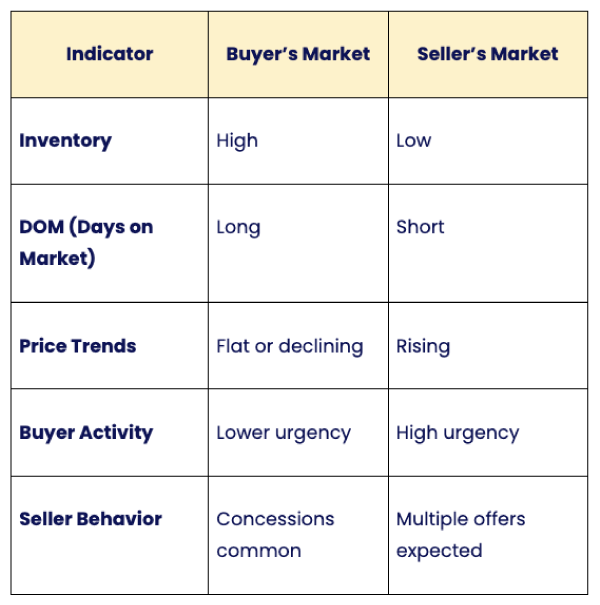
These signals together paint a clear picture. No single metric tells the full story, but when several line up, the market direction becomes easier to identify.
Beyond the basics, here are a few practical ways to stay ahead of market shifts:
✅ Review local MLS data weekly instead of relying on monthly headlines
✅ Use Espresso Agent’s Neighborhood Search to spot hot and cold zip codes where conditions differ from the broader market
✅ Speak with appraisers and title representatives to uncover early trends before they appear in public data
How Espresso Agent Supports Success in Any Market
No matter how the market shifts, agents who stay proactive tend to outperform those who react late. The right systems help you stay consistent, visible, and fast, regardless of conditions.
Here’s how Espresso Agent supports agents across both buyer’s and seller’s markets, so your strategy adapts without starting from scratch each time conditions change.
✅ Expired and FSBO leads for off-market opportunities
Expired and FSBO listings matter in every market, just for different reasons. In a buyer’s market, these sellers are often discouraged and open to clearer guidance. In a seller’s market, early outreach can secure listings before competition increases. Espresso Agent centralises access to these leads so you can engage early and position yourself as a helpful resource, not a last-minute option.
✅ CRM and dialer for faster follow-up
Speed-to-lead remains a deciding factor in both slow and fast markets. In competitive seller’s markets, fast follow-up can be the difference between winning or losing a listing. In buyer-friendly markets, consistent follow-up keeps conversations alive until timing aligns. Espresso Agent’s integrated CRM and dialer remove delays and keep outreach organised, timely, and professional.
✅ StoryTellr video to build trust quickly
Trust influences decisions in every market, but it becomes even more important when competition is high. StoryTellr lets you use short, personal videos to introduce yourself, share success stories, or explain local market conditions.
Video helps prospects connect with you before the first conversation, which lowers friction and improves response rates when sellers are choosing between agents.
✅ Drip campaigns to nurture leads through market shifts
Not every buyer or seller is ready to act right away, especially when conditions feel uncertain. Drip campaigns allow you to stay visible without constant manual outreach.
Espresso Agent’s drip tools deliver value-driven messages over time, so you remain top of mind until prospects are ready to move. This consistency turns patience into long-term opportunity, even as the market changes.
Buyer’s Market vs Seller’s Market: What It Means for You
At its core, the difference between a buyer’s market and a seller’s market comes down to supply and demand. When there are more homes than buyers, buyers hold the advantage. When demand outweighs supply, sellers gain the upper hand. Understanding this distinction is central to navigating the buyer’s market vs seller’s market landscape with confidence.
For agents, recognising the current market is not optional. It shapes pricing strategies, negotiation tactics, prospecting efforts, and client communication. When you understand the market clearly, you can set realistic expectations, adjust your approach quickly, and provide guidance that builds trust rather than frustration.
Markets will continue to shift, often faster than headlines suggest. Agents who stay agile, monitor local data closely, and adapt their strategies are the ones who remain competitive over the long term. With the right systems in place, you can succeed in any environment.
To support that adaptability, explore Espresso Agent’s pricing to see how the platform helps you stay effective, responsive, and visible in both buyers’ and sellers’ markets.


How Much Do New Real Estate Agents Actually Make
How much do new real estate agents make? Most earn $15K–$55K in Year 1. We break down the ranges, the splits, and what actually moves the needle.

New Real Estate Agent Tips
The first 30 days feel impossible without a system. Here's exactly what to do as a new real estate agent – one hour, one lane, real results.

Real Estate Prospecting Tips for New Agents in 2026
WHAT IS REAL ESTATE PROSPECTING? It’s all about finding new clients. If you are new to real estate, chances are you will use some combination of the...
